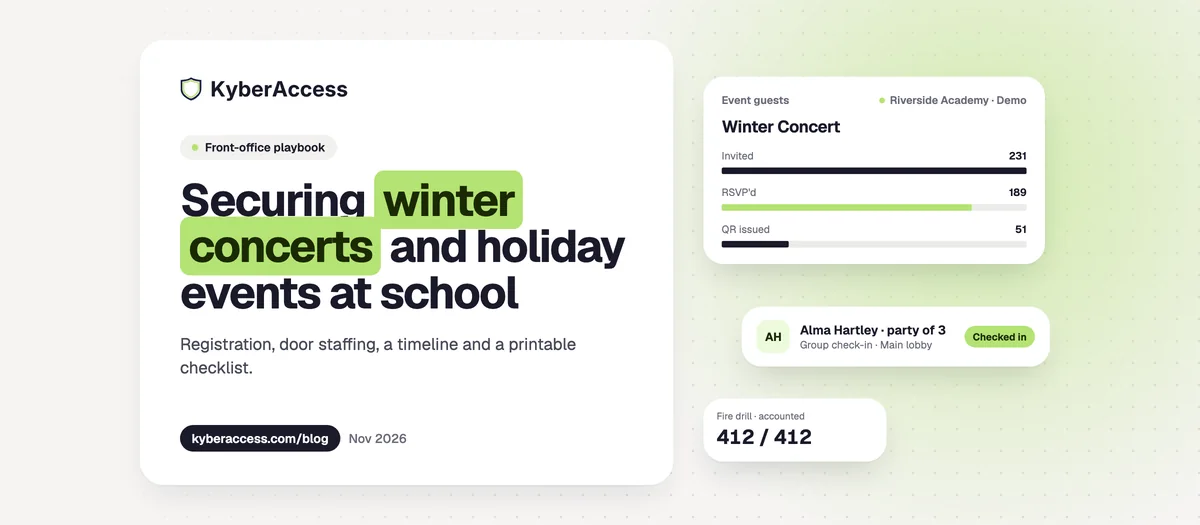
Every December, schools that run a tight front door all day open the building at 6:30 p.m. and let several hundred people in through the gym lobby. Winter concerts and holiday programs are some of the best evenings of the year. They are also the evenings when the front office has the least control over who is inside.
During the day, students and staff are on a roster, visitors sign in at one entrance, and anyone unexpected gets a second look. On concert night most guests are on no list, they arrive within the same twenty minutes, some come in through a side door propped open for the risers, and the person who runs the front desk went home at 4:00.
This playbook is for whoever owns that evening: office managers, assistant principals, facilities and safety coordinators. It covers what to decide in the weeks before, how to staff the door, the situations that come up every year, and how to fold the evening into your emergency plan. None of it needs new hardware.
Why winter events are different from the school day
A school event is a public gathering that happens to be in a school. CISA describes public gatherings as easy to get into, crowded and often lightly secured, and its advice comes down to a few habits: connect with local authorities, plan for incidents, train staff and volunteers, and report concerns (CISA, Securing Public Gatherings).
Winter adds its own problems:
- It is dark. Lots and side doors that feel fine at 3:00 p.m. are poorly lit by 5:00, and people cut across to the nearest door.
- Coats and bags. Guests arrive bundled, with flowers, instrument cases and strollers.
- Guests you do not know. Grandparents, older siblings, neighbors. Many have never been in the building.
- Custody orders still apply. A court order that limits who may contact a child does not pause for the concert.
- Thin staffing. The people who know the building best are on stage or backstage.
- Weather. Snow and ice change exit routes, parking and sometimes the date.
None of this means the evening should feel like airport security. The goal is narrower: know roughly who is inside, keep students supervised, control the doors, and be able to account for people if something goes wrong.
Six decisions to make before you send the invitation
Settle these with your principal or head of school, write the answers down, and share them with everyone working the evening.
1. Is the event open, registered, or ticketed?
Pick one and say so in the invitation.
- Open: anyone may walk in. You count people but have no names.
- Registered: families RSVP with party size. The best fit for most concerts.
- Ticketed: a set number of seats per family, when the room cannot hold everyone.
A short form is enough: family name, student's name, number of guests, an optional accessibility question. Set a close date, and use a waitlist if the room is likely to fill.
2. What is the real capacity of the room?
Your fire marshal or building code sets the occupant load for assembly spaces, and the Life Safety Code many jurisdictions adopt has specific requirements for them (NFPA 101). Find the posted load for the room, allow for the risers and stage, and set your registration cap below it. Extra folding chairs must not block aisles or exits.
3. Which doors will be open, and who stands at each one?
Choose one public entrance, two at most, and secure every other door against entry from outside. Exit doors still have to open from the inside. Light and sign the route from the parking lot.
4. Where are students, and who is responsible for them?
Write down which rooms performers wait in, which adult supervises each group, and where students go after they perform. Decide whether they join families afterward or stay with their class until release. A student who walks off stage and out a side door to find a parent is the most common gap at school performances.
5. Who is screened, and how?
- Registered guests: check names against the RSVP list.
- Anyone beyond the public area: backstage volunteers, the parent helping with costumes, the alum on the sound board. Check them in through your normal daytime visitor process, ID scan included.
- Known concerns: if someone has a no-contact order or a watchlist entry, decide in advance who handles it. Never leave that judgment to a volunteer.
6. How will you account for people in an emergency?
If the alarm goes off at 7:15, you need three answers within minutes: are all students accounted for, are all staff and volunteers accounted for, and roughly how many guests were inside? Your emergency operations plan probably covers the school day. Check it covers evening events too: who carries which roster, and where each group assembles.
Staffing the door
A good door is a few calm adults at a table with a list, not a checkpoint. For one public entrance:
| Role | Who | What they do |
|---|---|---|
| Greeter | Staff member who knows families | Welcomes people, notices anyone lost or out of place |
| Check-in | Staff or trained volunteer | Scans the guest's QR code or finds the family on the list, records party size |
| Door lead | Administrator on duty | Handles exceptions: a name not on the list, a known concern, a guest who needs help |
| Floater | Custodian or facilities staff | Walks the building, checks side doors and exits |
Brief everyone before doors open: where the students are, which doors are open, how to reach the door lead (radio or group text), and the one sentence for anyone not on the list: "Let me get someone who can help you." Volunteers never refuse entry or confront anyone. Keep a printed guest list in case the Wi-Fi drops.
The event timeline
Use this as a starting point and adjust it to your calendar.
| When | Task | Owner |
|---|---|---|
| 4 weeks before | Confirm date, room, occupant load, weather date and event type. | Principal, facilities |
| 3 weeks before | Publish the invitation with the RSVP form, party-size limit and registration close date. | Office manager |
| 3 weeks before | Confirm custodial and administrator coverage. Review custody and no-contact orders with the counselor or registrar. | Administrator |
| 2 weeks before | Send a reminder. Plan parking, the public entrance and the lighting for the walk in. | Office manager, facilities |
| 1 week before | Close registration or open the waitlist. Assign door roles. Screen new backstage volunteers. | Office manager |
| 2 days before | Final reminder: arrival time, entrance, parking. Print a backup list. | Office manager |
| Day of, 2 hours before | Walk the building. Secure non-public doors. Test exit lights. | Facilities |
| Day of, 30 minutes before | Brief door staff. Confirm student holding rooms and supervising adults. | Door lead |
| During | Check guests in. Keep a running headcount. Floater walks the building every 20 to 30 minutes. | Door team |
| After | Release students only to their families or as planned. Walk the building before locking up. | Teachers, facilities |
| Next school day | Review attendance and incidents; update the plan for spring. | Administrator |
Four situations that come up every year
A guest is not on the list
Usually a grandparent whose RSVP went under another family, or someone who forgot. The door lead asks which student they are here for, checks with the family, and adds them if there is space. Registration exists to give you names and a count, not to turn away relatives.
A parent arrives who is not allowed contact with a student
Plan this one most carefully. Before the event, whoever knows about the order briefs the door lead in person. Agree who speaks to the person, where the student is, and when to call the police. Keep it need-to-know: student records are protected by FERPA (U.S. Department of Education), and a list of court orders does not belong on a volunteer table.
A student goes missing between the stage and the audience
Set one rule and tell families beforehand: students stay with their class until a teacher releases them. If a student cannot be found, the teacher alerts the door lead, the floater checks side doors and the parking lot, and families check the audience.
The fire alarm goes off
Teachers take students to their assembly point and take attendance. The door lead brings the guest list and headcount. Send guests to a separate area so teachers can count classes without crowds of parents. Plan a reunification point and a release process so you know who left with whom.
Use the concert as a drill rehearsal
Evening events test a different version of your plan: different staff, different doors, and hundreds of people who have never seen your evacuation map. SchoolSafety.gov recommends tailoring exercises and drills to your school community and using them to practice the emergency operations plan (SchoolSafety.gov). CISA's K-12 School Security Guide gives a framework for assessing the whole building, after-hours use included.
You do not need to pull the alarm during a concert. A tabletop review a week before, with the door lead, the custodian and two teachers, finds most gaps. Ask:
- Who has the roster of students performing tonight?
- Who has the guest list, and is it on paper as well as on a screen?
- Where does each group assemble, and is that area lit and clear of snow?
- Who tells families where to go?
- How do we know when everyone is out?
After your next daytime drill, note what slowed the count down. It will be slower at night.
A checklist you can print
Four weeks out
- Date, room and weather date confirmed
- Occupant load for the room checked, registration cap set below it
- Event type decided: open, registered or ticketed
- Administrator on duty and custodial coverage confirmed
Two to three weeks out
- Invitation sent with RSVP form, party-size limit and close date
- Custody and no-contact orders reviewed with the door lead in person
- Public entrance chosen, route lit, all other entrances will be locked
- Parking plan and accessible drop-off decided
One week out
- Registration closed or waitlist on
- Door roles assigned: greeter, check-in, door lead, floater
- Backstage volunteers checked in through the normal visitor process
- Tabletop walk-through of the fire-alarm scenario done
Day of
- All non-public doors locked and checked, exit lights tested
- Student holding rooms and supervising adults confirmed
- Door staff briefed, radios or group text working
- Guest list open on a device and printed as a backup
- Running headcount kept during arrival
After
- Students released only as planned
- Building walked before lockup
- Attendance and incidents reviewed the next school day
Where software helps, and where it does not
A spreadsheet and a clipboard can run a good event. Software helps with the tedious parts: RSVPs, reminders, fast check-in and a live count.
In KyberAccess, events have an RSVP form with your own questions, a capacity limit and optional waitlist, a cap on extra guests, and confirmation emails with each family's QR code and a calendar file. At the door, staff scan codes on a kiosk or phone, check in a whole family at once, or check someone in by hand from the list. The guest pipeline updates as people arrive.
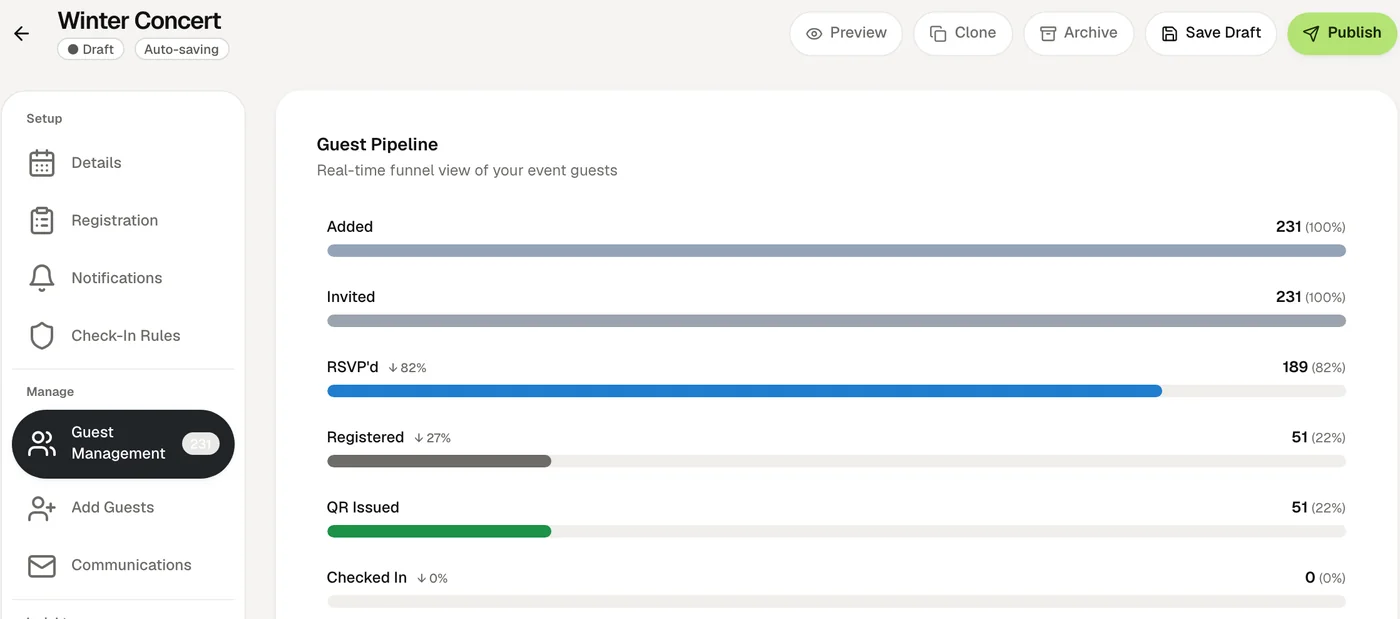
Backstage volunteers can use the normal visitor check-in with an ID scan and screening. A screening match or a name mismatch goes to the Review Queue for staff to decide, never to a volunteer. Regular volunteers can carry a Wallet credential, and student dismissal checks guardians against the authorized pickup list.
In an emergency, the evacuation screen shows a live roster of visitors checked in at the front desk, and staff mark each person safe. The history keeps every activation, drills included, with who started it, how long it lasted and the count.
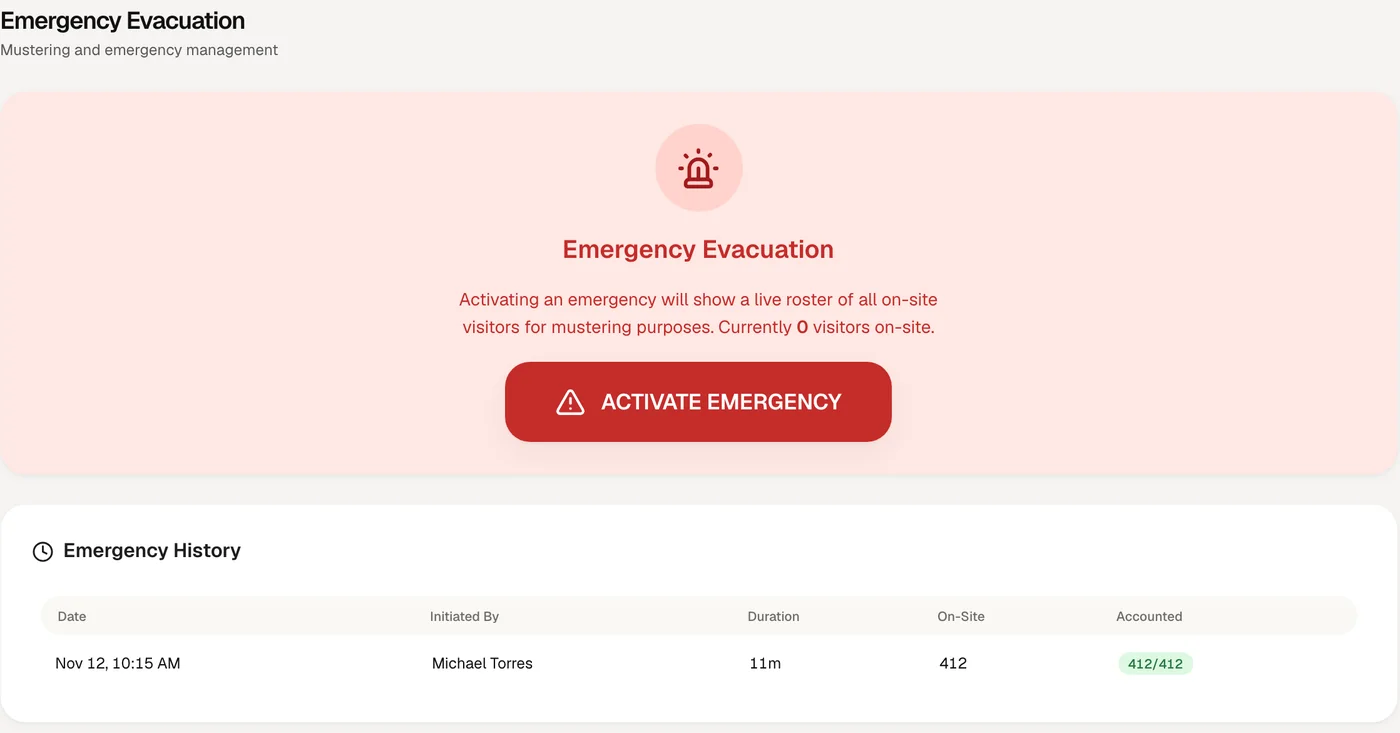
One honest limit: the evacuation roster and the event guest list are separate. The guest list gives you the event headcount; the visitor roster covers everyone checked in at the front desk. Make sure the door lead knows which is which.
Related reading: our back-to-school security audit checklist, event check-in and registration, visitor tracking in an evacuation, and the K-12 schools page.
Frequently asked questions
Do we need to check ID for every guest at a school concert?
Usually not. Most schools check names against the RSVP list and keep a headcount. Check ID for anyone going beyond the public area, such as backstage volunteers, and whenever the door lead asks. Decide the rule in advance and apply it to everyone.
How far in advance should registration close?
Two to five days before. That leaves time to compare the count with the occupant load, open a waitlist and print a backup list. Leave room for a few walk-ins.
What should volunteers do if someone is not on the guest list?
Volunteers should not refuse entry or argue. They say "Let me get someone who can help you" and call the door lead, who checks with the family and adds the guest if there is space.
How do we handle custody or no-contact orders at evening events?
The staff member who knows about the order briefs the door lead in person beforehand and agrees who speaks to the person, where the student is, and when to call the police. Keep details need-to-know and off volunteer tables.
Should we run a fire drill during a concert?
No need to sound the alarm with families inside. Run a short tabletop review a week before: walk through the fire-alarm scenario, confirm who carries each roster, and check that assembly areas are lit and clear.